
Obsessive-Compulsive Disorder (OCD) is a mental health condition that can affect a person’s thoughts, emotions, daily habits, relationships, and quality of life. People experiencing OCD may have unwanted, recurring thoughts or fears that cause distress. To reduce this distress, they may feel compelled to perform certain actions or mental rituals repeatedly. Understanding these symptoms is an important first step toward seeking OCD treatment in Bhopal.
OCD is more than simply liking cleanliness, following routines, or being particular about things. It can become time-consuming and interfere with work, studies, family responsibilities, and personal well-being. With appropriate assessment and evidence-based treatment, many people learn to manage their symptoms and improve their daily functioning. A qualified Psychiatrist in Bhopal can help individuals understand their symptoms and explore suitable care options. Recognizing the warning signs early can help people understand when professional support may be beneficial. When exploring OCD treatment in Bhopal, it is important to verify a mental health professional’s qualifications, relevant experience, and available services before arranging a consultation.
Understanding OCD and Its Impact on Daily Life
Obsessive-Compulsive Disorder generally involves two main features: obsessions and compulsions. Obsessions are recurring thoughts, images, doubts, or urges that feel unwanted and distressing. Compulsions are repetitive behaviours or mental acts that a person feels driven to perform to reduce anxiety or prevent something they fear. Understanding these patterns is an important part of exploring OCD treatment in Bhopal.
For example, someone may repeatedly worry that their hands are contaminated, even after washing them. They may wash their hands several times to feel temporarily reassured. Another person may repeatedly check a door lock because of persistent doubts about whether it is secured. These experiences may indicate a need to discuss symptoms with a qualified Psychiatrist in Bhopal.
These patterns can become difficult to control, particularly when the relief from a compulsion lasts only briefly. A person may begin repeating the behaviour whenever the anxiety returns. When these experiences affect everyday functioning, learning about OCD treatment in Bhopal can help individuals understand the importance of assessment and appropriate support.
OCD can affect people of different ages and backgrounds. It is not a personal weakness, a lack of discipline, or a sign that someone is choosing to behave irrationally. People experiencing these symptoms deserve understanding rather than criticism, and a qualified Psychiatrist in Bhopal can help them explore appropriate care.

Common OCD Symptoms and Warning Signs
OCD symptoms differ from person to person. Some individuals experience mostly contamination-related fears, while others struggle with checking, intrusive thoughts, symmetry, ordering, or mental rituals. Recognizing these patterns can help someone decide whether a consultation with a qualified Psychiatrist in Bhopal may be appropriate.
1. Repeated Intrusive Thoughts
Intrusive thoughts are unwanted thoughts, images, or urges that enter the mind repeatedly. They may involve fears about contamination, making mistakes, causing accidental harm, or losing control. These thoughts can feel upsetting, especially when they conflict with a person’s values. Understanding recurring intrusive thoughts can be an important step toward seeking OCD treatment in Bhopal. Having an unwanted thought does not mean that a person wants it to happen or will act on it. However, when someone spends significant time trying to suppress, neutralize, or obtain certainty about such thoughts, professional assessment may be helpful. A qualified Psychiatrist in Bhopal can evaluate these experiences in the context of other symptoms.
2. Excessive Washing or Cleaning
Some people with OCD experience persistent fears about germs, dirt, chemicals, or contamination. They may wash their hands repeatedly, clean household objects excessively, change clothes frequently, or avoid touching items they consider contaminated. When these behaviours become difficult to control, an assessment for OCD treatment in Bhopal may be appropriate.
Ordinary hygiene is a normal part of daily life. The concern arises when cleaning becomes difficult to control, consumes considerable time, causes skin irritation, or interferes with routine activities. Evidence-based OCD treatment in Bhopal may involve psychological approaches designed to help people respond differently to these fears.
3. Repeated Checking
Repeated checking may involve doors, electrical switches, appliances, documents, messages, or other everyday responsibilities. A person may check an item several times but still feel uncertain immediately afterwards. If this pattern repeatedly interferes with daily responsibilities, a consultation with a Psychiatrist in Bhopal may help clarify the cause.
The checking often aims to prevent a feared event or relieve anxiety. However, repeated checking can reinforce the cycle of doubt and temporary reassurance. If this pattern disrupts sleep, punctuality, work, or family life, discussing it with a qualified mental health professional can be a useful step toward OCD treatment in Bhopal.
4. A Strong Need for Symmetry or Order
Some individuals feel distressed when objects appear uneven, arrangements seem incomplete, or activities do not feel exactly right. They may repeatedly arrange items, repeat movements, or restart tasks until they experience a sense of completion. When these urges cause distress or interfere with daily life, professional assessment for OCD treatment in Bhopal may be helpful.
Enjoying an organized environment is not automatically a sign of OCD. The key consideration is whether the urge feels difficult to resist and causes significant distress or functional difficulties. A qualified Psychiatrist in Bhopal can help assess whether these experiences may be associated with OCD or another concern.
5. Repeating Actions or Counting
A person may feel compelled to count, repeat words, touch objects, walk through a doorway again, or perform actions in a specific sequence. Sometimes, these behaviours are connected to a feared consequence. In other cases, the person feels that something is incomplete until the action is repeated. These patterns may warrant assessment when exploring OCD treatment in Bhopal.
These rituals may provide short-term relief, but the anxiety can return and lead to further repetition. If these behaviours take up substantial time or interfere with daily responsibilities, exploring OCD treatment in Bhopal can be a useful step toward understanding the problem.
6. Mental Rituals and Seeking Reassurance
Not all compulsions are visible. Some people repeatedly review memories, mentally repeat phrases, count silently, or try to prove to themselves that a feared possibility is not true. These less visible symptoms can also be discussed during an assessment with a qualified Psychiatrist in Bhopal.
Repeatedly asking family members for reassurance can also become part of the cycle. Although reassurance may reduce anxiety temporarily, the need for certainty can return. Understanding these symptoms is important when considering OCD treatment in Bhopal because OCD does not always involve obvious cleaning or checking behaviours.
How OCD Differs from Ordinary Habits
Many people double-check important tasks, prefer clean surroundings, or follow regular routines. These behaviours alone do not establish that someone has OCD. The difference often lies in the level of distress, the sense of compulsion, the amount of time involved, and the impact on everyday life. These factors are important when considering OCD treatment in Bhopal. For example, checking that a door is locked once before leaving home is a common safety habit. Returning repeatedly because of intrusive doubts, despite remembering the initial check, may indicate a pattern that deserves further assessment. A Psychiatrist in Bhopal can help evaluate whether such experiences are consistent with OCD.
Similarly, keeping a room tidy is different from feeling unable to leave it until every object is arranged according to rigid rules. OCD-related behaviours often feel driven by anxiety rather than personal preference. Recognizing this difference can help people understand when OCD treatment in Bhopal may be beneficial. A diagnosis cannot be made from a single symptom or online checklist. If recurring thoughts and behaviours are difficult to control, a qualified Psychiatrist in Bhopal can assess the overall pattern, duration, distress, and impact on daily functioning.
What Causes Obsessive-Compulsive Disorder?
There is no single cause of OCD. Research suggests that biological, genetic, psychological, and environmental factors may contribute to its development. Having a family history of OCD may increase vulnerability, but it does not mean that a person will necessarily develop the condition. Understanding these factors can help individuals approach OCD treatment in Bhopal without unnecessary self-blame. Differences in brain functioning and the way certain neural circuits regulate thoughts, habits, and responses to uncertainty may also play a role. Stressful experiences can sometimes intensify existing symptoms, although stress alone does not explain every case. A qualified Psychiatrist in Bhopal can consider these factors during an individual assessment.
OCD is not caused simply by poor parenting, a lack of willpower, or a person’s character. People should not blame themselves for experiencing intrusive thoughts or compulsive urges. A compassionate approach to OCD treatment in Bhopal recognizes that these symptoms can be distressing and are not usually under simple voluntary control. Understanding these factors can support a more compassionate approach to care. OCD treatment in Bhopal should be based on an individual’s symptoms, needs, medical history, and professional assessment rather than assumptions about the cause.
When Should You Seek Professional Help for OCD?
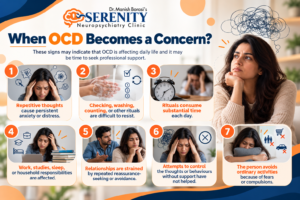
It may be time to seek professional help when intrusive thoughts or repetitive behaviours begin affecting everyday life. The following signs can indicate that an assessment for OCD treatment in Bhopal would be useful:
- Repetitive thoughts cause persistent anxiety or distress.
- Checking, washing, counting, or other rituals are difficult to resist.
- Rituals consume substantial time each day.
- Work, studies, sleep, or household responsibilities are affected.
- Relationships are strained by repeated reassurance-seeking or avoidance.
- Attempts to control the thoughts or behaviours without support have not helped.
- The person avoids ordinary activities because of fears or compulsions.
There is no need to wait until symptoms become severe before seeking help. A qualified Psychiatrist in Bhopal can discuss the symptoms, assess possible explanations, and help determine whether treatment or referral for psychological therapy may be appropriate.
If a person experiences an immediate risk of self-harm or cannot remain safe, urgent assistance should be sought through local emergency services. In India, the emergency number is 112. Seeking timely professional support for OCD treatment in Bhopal can help individuals understand their options before symptoms become more disruptive.
How Is OCD Diagnosed?
OCD diagnosis requires a professional assessment. A clinician may ask about the nature of intrusive thoughts, the behaviours or mental rituals that follow, how frequently they occur, and how much they interfere with daily life. This assessment helps determine whether OCD treatment in Bhopal may be appropriate.
The assessment may also explore when symptoms began, whether they have changed over time, and whether other mental health or medical concerns could contribute to the experiences. There is no single blood test or brain scan that independently confirms OCD in routine clinical practice. A Psychiatrist in Bhopal may recommend further assessment when needed.
The clinician may consider whether the obsessions or compulsions are time-consuming, cause significant distress, or interfere with important areas of functioning. They may also assess whether the symptoms are better explained by another condition. This careful evaluation is an important part of planning OCD treatment in Bhopal. Being open about symptoms can help make the assessment more useful. People sometimes feel embarrassed about intrusive thoughts, but unwanted thoughts do not automatically reflect intentions or character. When considering Dr. Manish Borasi for a consultation, verify his professional qualifications, relevant experience, and available services directly before deciding whether to proceed with OCD treatment in Bhopal.
Evidence-Based OCD Treatment Options
OCD treatment is individualized. The appropriate approach depends on symptom severity, personal preferences, other health concerns, and the person’s response to previous care. Treatment may include psychological therapy, medication, or a combination of both. A qualified Psychiatrist in Bhopal can discuss suitable options following an assessment.
Cognitive Behavioural Therapy (CBT)
Cognitive Behavioural Therapy is a structured form of psychotherapy that helps people understand the relationship between thoughts, emotions, and behaviours. It can help individuals identify patterns that maintain anxiety and develop healthier ways of responding to distressing experiences. CBT may form part of an evidence-based plan for OCD treatment in Bhopal.
For OCD, CBT often includes techniques specifically adapted to obsessive thoughts and compulsive behaviours. Treatment is usually planned collaboratively, with goals and exercises suited to the individual’s needs. When exploring OCD treatment in Bhopal, individuals can ask whether appropriately trained psychological therapists are available.
Exposure and Response Prevention (ERP)
Exposure and Response Prevention is a specialized form of CBT commonly used for OCD. It involves gradually facing situations, thoughts, or triggers that cause anxiety while learning to resist the usual compulsive response. ERP is an important evidence-based approach to discuss when exploring OCD treatment in Bhopal.
For example, under the guidance of a trained therapist, a person who repeatedly checks an item may gradually practise reducing the checking behaviour. The process is planned carefully and adjusted according to the person’s circumstances. A qualified Psychiatrist in Bhopal may help coordinate care or refer the individual to a therapist trained in ERP.
ERP is not about forcing someone into overwhelming situations. It is a structured therapeutic approach intended to help people learn that anxiety can change without repeatedly performing rituals. When exploring OCD treatment in Bhopal, asking about access to qualified professionals trained in evidence-based OCD therapy may be useful.
Medication
Medication may be recommended for some people with OCD. Selective serotonin reuptake inhibitors (SSRIs) are among the medicines commonly used, depending on the clinical assessment and individual needs. A qualified Psychiatrist in Bhopal can discuss whether medication may be suitable as part of an OCD treatment plan.
Medication decisions should be made with a qualified prescribing clinician. The choice of medicine, dosage, possible side effects, and follow-up schedule require professional guidance. People should not start, stop, or change psychiatric medication without consulting their prescriber when receiving OCD treatment in Bhopal.
Medication does not work in the same way for everyone, and improvement may take time. A Psychiatrist in Bhopal can discuss the potential benefits, risks, and alternatives in the context of the person’s symptoms and medical history.
Combined Treatment and Follow-Up
Some individuals benefit from a combination of medication and psychological therapy. Others may begin with one treatment approach and adjust the plan based on progress, preferences, and clinical advice. Individualized planning is an important part of OCD treatment in Bhopal.
Follow-up appointments can help review symptom changes, side effects, treatment goals, and any difficulties with therapy exercises. Treatment plans may need adjustment over time, and progress does not always happen in a straight line. Regular communication with a qualified Psychiatrist in Bhopal can help address concerns as they arise.
People should discuss any concerns about treatment openly with their clinician. OCD treatment in Bhopal should focus on a safe, individualized plan rather than promises of guaranteed or immediate results.
Practical Ways to Support Daily Well-Being
Professional treatment is important when OCD symptoms cause significant distress, but certain everyday practices may support general well-being alongside appropriate care. People exploring OCD treatment in Bhopal can discuss which strategies are suitable for their individual circumstances.
Maintain a Consistent Routine
A regular schedule for sleeping, eating, working, and relaxing can provide structure. A routine should remain flexible rather than becoming another set of rigid rules that the person feels compelled to follow. These habits may complement an individualized plan for OCD treatment in Bhopal.
Learn to Recognize Symptom Patterns
Noticing when intrusive thoughts or compulsions occur can help individuals and clinicians understand common triggers. Keeping brief notes may be useful, provided that recording does not itself become a repetitive ritual. A qualified Psychiatrist in Bhopal can advise whether symptom tracking may be helpful.
Avoid Blaming Yourself
OCD symptoms can be confusing and frustrating. Treating yourself with patience rather than shame may make it easier to discuss symptoms and participate in treatment. Unwanted thoughts are not the same as intentions, and this understanding can support the process of seeking OCD treatment in Bhopal.
Seek Support from Trusted People
Friends and family members can provide emotional support by listening without judgment. They may also learn how repeated reassurance or participation in rituals can unintentionally maintain the OCD cycle. Professional guidance can help families provide appropriate support alongside OCD treatment in Bhopal.
Follow Professional Guidance
Self-help techniques should not replace professional assessment when symptoms are persistent or disruptive. People seeking OCD treatment in Bhopal can discuss which daily strategies may complement their individual treatment plan.
Supporting a Family Member with OCD
OCD can affect family members as well as the person experiencing symptoms. Loved ones may feel unsure how to respond when someone repeatedly asks questions, checks objects, or avoids certain situations. Understanding these patterns can help families support someone exploring OCD treatment in Bhopal.
A supportive approach starts with listening and acknowledging the person’s distress without criticizing them. Avoiding statements such as “just stop thinking about it” can help reduce shame, since OCD symptoms are not usually under simple voluntary control. A qualified Psychiatrist in Bhopal can help families understand the condition.
At the same time, repeatedly providing reassurance or participating in rituals may unintentionally reinforce the cycle. Families can work with a qualified therapist to understand how to respond compassionately while supporting recovery goals during OCD treatment in Bhopal.
Encouraging professional help without pressure is often more constructive than arguing about whether a fear is reasonable. A mental health professional can help families understand treatment options and ways to provide appropriate support.
Finding Mental Health Support in Bhopal for OCD
When looking for care, consider the professional’s qualifications, experience with OCD, treatment approach, communication style, and availability for follow-up. It is reasonable to ask whether the clinician works with evidence-based treatment approaches such as CBT and ERP or can refer to a suitably trained therapist when exploring OCD treatment in Bhopal.
Individuals considering OCD treatment in Bhopal should verify the professional’s credentials and the services offered before making an appointment. Treatment suitability depends on the individual’s needs, and no provider can guarantee a particular result.
Dr. Manish Borasi may be considered as a consultation option only after independently confirming his qualifications, clinical services, and appointment availability through an official or reliable source. A consultation can provide an opportunity to explain symptoms, ask questions, discuss concerns about privacy, and understand possible next steps for OCD treatment in Bhopal.
Before contacting Dr. Manish Borasi, confirm whether his current services include assessment or care relevant to OCD and whether referral to a qualified therapist is available if needed. Verifying these details can help individuals make an informed decision about seeking OCD treatment in Bhopal.
When searching for OCD treatment in Saraswati Nagar, confirm the clinic’s exact location, the clinician’s credentials, and whether the required services are available there. Location alone does not establish a professional’s qualifications or suitability for a particular condition.
Frequently Asked Questions About OCD Treatment in Bhopal
1. What are the common symptoms of OCD, and when should I seek OCD treatment in Bhopal?
Common symptoms include intrusive thoughts, repeated checking, excessive washing, counting, arranging objects, and mental rituals. These symptoms are more concerning when they cause distress, take up considerable time, or interfere with daily functioning. A qualified clinician can assess whether the pattern is consistent with OCD.
2. When should I consult a Psychiatrist in Bhopal for OCD?
Consider an assessment if repetitive thoughts or behaviours are difficult to control, cause substantial anxiety, or affect work, relationships, sleep, or other responsibilities. A professional can assess your symptoms and discuss suitable treatment options for OCD treatment in Bhopal.
3. Can OCD be treated without medication through OCD treatment in Bhopal?
Some people may benefit from psychological therapy, including CBT with Exposure and Response Prevention, without medication. The most appropriate plan depends on symptom severity, individual needs, and clinical assessment. Discuss the available options with a qualified professional rather than changing medication independently.
4. How does CBT help with OCD treatment in Bhopal?
CBT helps people understand how thoughts, emotions, and behaviours interact. For OCD, it may include ERP, in which individuals gradually face anxiety-provoking situations while learning to reduce compulsive responses. Therapy should be tailored to the person’s circumstances and delivered by an appropriately trained professional.
5. Does having intrusive thoughts mean someone will act on them, and can OCD treatment in Bhopal help?
No. Unwanted intrusive thoughts do not automatically indicate intention or a desire to act. Such thoughts can be distressing precisely because they conflict with a person’s values. A clinician can help assess the experiences and distinguish intrusive thoughts from other concerns.
6. How can family members support someone seeking OCD treatment in Bhopal?
Family members can listen without judgment, encourage professional support, and learn how to respond to reassurance-seeking or rituals without reinforcing them. A therapist can provide guidance suited to the individual’s needs and family circumstances.
7. Is OCD only related to cleanliness, or are other symptoms relevant to OCD treatment in Bhopal?
No. OCD may involve contamination fears, but it can also involve checking, symmetry, unwanted thoughts, counting, repeating actions, or mental rituals. Symptoms vary from person to person, and cleanliness preferences alone do not establish OCD.
8. How can I choose a Psychiatrist in Bhopal for OCD concerns?
Check professional qualifications, experience with OCD, the treatment approaches offered, communication style, and follow-up arrangements. You can ask whether the clinician provides or coordinates evidence-based therapies such as CBT and ERP. Dr. Manish Borasi is an option to investigate only after independently verifying his qualifications and relevant services.
9. Where can I look for OCD treatment in Saraswati Nagar?
You can search for qualified mental health professionals serving Saraswati Nagar and nearby areas, then verify their exact location, credentials, and available services directly. Do not assume a clinician provides OCD care solely because their name appears in a local search result.
10. Can OCD symptoms return after improvement, and when should I seek OCD treatment in Bhopal again?
Symptoms may fluctuate over time, and some people experience periods of increased difficulty. Continued use of learned strategies, follow-up care when needed, and early discussion of returning symptoms may help individuals manage changes. A clinician can advise on the most appropriate ongoing support.
Conclusion: Recognizing OCD Symptoms and Finding OCD Treatment in Bhopal
OCD can affect thoughts, emotions, routines, and relationships, but it is a recognized mental health condition for which evidence-based treatment options are available. Recognizing repeated intrusive thoughts, compulsions, and their effect on everyday functioning can help people decide when to seek professional assessment.
People exploring OCD treatment in Bhopal can begin by speaking with a qualified mental health professional about their symptoms and treatment preferences. CBT, particularly Exposure and Response Prevention, and medication when clinically appropriate may form part of an individualized care plan.
If you are considering Dr. Manish Borasi for a consultation, verify his qualifications, OCD-related services, and appointment details through a reliable source before proceeding. The goal is to find suitable, evidence-based support that respects individual needs and promotes long-term well-being.
Seeking help is a constructive step. With appropriate assessment, professional guidance, and continued support, people experiencing OCD can work toward managing symptoms and participating more comfortably in daily life. A qualified Psychiatrist in Bhopal can help individuals understand available options and determine the next appropriate steps.